Evan Diaz
Creator of Nimble, Nimble Co.
We sat down with Evan Diaz, the creator of Nimble, to talk about the design calls behind the fast 5e alternative: monster math, bosses that act after every hero, why Nimble cut the roll to hit, and what's next.
Evan's games
Chapters
- 0:00Meet Evan Diaz
- 1:33From 5e house rules to Nimble
- 3:48Monsters sorted by ecosystem
- 6:18Designing the unicorn
- 7:06The monster builder: 300 hours so you don't have to
- 8:44Legendary monsters and the drama curve
- 12:23Bosses that act after every hero
- 14:59Running 5e legendary monsters
- 16:50Monsters organized by group
- 20:16TPKs that don't end the campaign
- 21:10"Just use bears"
- 21:36The d4 monster that drops you to 0
- 22:46Why Nimble has no roll to hit
- 25:23Crits, misses, and the d6 vs. the d12
- 27:25Three actions, reactions and Assess
- 30:09Defend after the hit
- 30:41Mana instead of spell slots
- 32:42What's next: Monsters & More and Kid Nimble
- 33:52Art direction
- 35:09Wrapping up
Transcript
Lightly edited for reading. Joe was out for Thanksgiving, so Blaine's wife Monica sat in as co-host.
0:04Blaine: I'm here with Evan Diaz, creator of Nimble. If you want to give us a little more background, we can get into that.
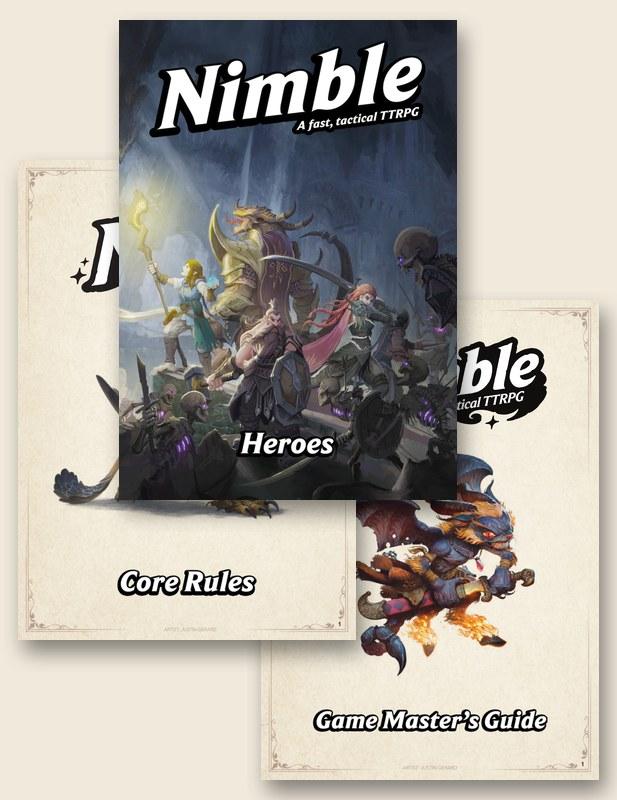
0:12Evan: Yeah, sure. Nimble is a tabletop role-playing game. It began as some house rules for 5e that I was running for my own table, and I figured other people might like it. It took off from there, so now it's its own game.
0:28Blaine: That's pretty awesome. What spurred all these house rules?
0:32Evan: At my table, I had players that ran the gamut. There were optimizers who knew all the things, like one guy who would 3D print his own stuff, and other people who never quite understood what a bonus action was or what proficiency bonus did. The optimizers had really cool characters, but their turns took forever. The others picked things based on vibes and never really understood what was happening mechanically. And then there were people in between who were just there to have a good time.
1:21Evan: But so much of the night was spent fiddling with the rules. The rules were in the way. So I really wanted to tinker with things. And also, I never wanted to be a DM. I just wanted to play. I just wanted to show up. But our DM left, so either someone had to volunteer or we didn't get to play anymore.
1:49Evan: I learned pretty quickly that it is hard. You have to learn a lot of things, you have to balance a lot of things, and I didn't like all that. So right away I started homebrewing, fixing things and tweaking things.
2:04Blaine: So I guess it's a natural progression. This was an optimization for you.
2:07Evan: Yeah, it was for my own sanity, honestly. It's a self-defense mechanism.
2:13Blaine: Was 5e your main game, or were there others? What were the inspirations for Nimble and your house rules?
2:24Evan: 5e was the first one I ever played. A buddy of mine at church invited me: "Hey, we're going to play some D&D." And I was like, I don't want to do that. But he was a good friend, so I figured I'd do it once to make him happy, and then I could say I did it and it's not for me. But we played, and it was a lot of fun. So I started with 5e, and things grew from there.
2:51Blaine: So you're kind of new to the hobby. I finished my review of the Nimble core book last night. It's one of my higher-scored RPGs. I really enjoyed the mechanics, and I'm looking forward to actually playing it.
3:06Evan: I'm glad. Did you review the first printing? Because now there's technically a second edition.
3:14Blaine: I think it's the 3.0. I'd done the Kickstarter, so I got all the digitals. Everybody kept saying, "You have to review Nimble," and I was like, okay, it's on my list. Then I started hunting, and I prefer physical copies, and I couldn't find any. Then I saw the late pledge on your site, and I was like, okay, we're doing this. So I jumped on the Monsters & More backing.
3:47Evan: Very cool.
3:48Blaine: And actually, your monster manual is probably one of my favorite monster manuals. I absolutely love how you divide monsters into ecosystems. I wish more RPGs would do that, because it's a pain trying to find a monster that fits a region.
4:05Evan: Oh, yeah. D, all the dragons.
4:08Blaine: Yeah. I don't need all the dragons.
4:11Evan: I need the dragon that lives here.
4:13Blaine: Yeah, I want to turn the page and find it. What led to that?
4:19Evan: Frustration. I want everything to be as easy as possible, so I can just play the game, and the rules, and even the physicality of the books, don't get in the way. Are bugbears under B, or are they with the goblins under G? And there's a bunch of Gs, there's giants and genies, and I have to flip through. It doesn't make any sense.
4:48Evan: I mean, it makes sense for someone who's going to read it like a textbook. But as an actual tool you use at the table, where time is of the essence and you don't want to miss a beat, it's not a very useful tool. So organizing them a little more intelligently, having stat blocks that aren't paragraphs of text, frees up more of the GM's bandwidth to have fun and do cool stuff, and not worry about running the thing perfectly or juggling a bunch of things in your mind all at the same time.
5:31Blaine: I really enjoyed reading your monsters. Some of them made me giggle. Do you have one that's a personal favorite?
5:41Evan: Whatever one I just worked on, I fall in love with that one. A lot of the monsters are relatively straightforward, but they're designed to work together in really interesting ways. So every individual monster doesn't need five or ten different abilities and a bunch of data points. Each one does its cool thing or two, but together with the other monsters in its group, they do really interesting things, just emergently. I really like how the unicorn worked out.
6:20Blaine: Yeah, the unicorn is really cool.
6:23Evan: It's not really the strongest monster, and it's sort of a weird creature. But you've got to have a unicorn in the monster manual. It's this level, so it has to deal roughly this much damage. How do I do that? It's not punching as hard as a hill giant. So what can we do to make it as difficult as it should be? Those are really interesting problems, and I think I landed on a pretty cool solution with that one. There's a bunch.
6:59Blaine: Speaking of monsters, like I said, I was going through the core book for my review, and your monster building template is probably one of my favorites. I mainly run Pathfinder, and their monster builder is eight pages or something to build out the stats. Yours is super simple, two pages. You pick here, and you can adjust higher or lower. How was figuring out the math for that simplicity?
7:37Evan: An incredible pain. An incredible pain. But if I can spend 300 hours making a chart and tuning it and playtesting it and making sure all the numbers are solid, then nobody else has to do that. So I'll spend months and months on the foundation, because every hour I spend on it is an hour that thousands and thousands of people don't have to.
8:05Evan: I see that as an investment in the future of the people who are going to be playing it and running it. I think it's a worthwhile thing that, unfortunately, is rarer than I think it should be. So I put a lot of thought into how easy it is to run, or to make your own things, and how clear it is what works and why it works.
8:33Blaine: Well, we appreciate it as GMs. When I saw it, I was like, man, you do so many things right. On the same topic, how did the legendary monsters come about? That's another thing I fell in love with. I have yet to run Nimble, but I can imagine those battles being quite epic. You have two different stages.
9:08Evan: Yeah. There's bloodied at half hit points, and then last stand.
9:13Blaine: Last stand, that's it. How did those come about?
9:19Evan: A lot of time. The problem was, in 5e the math basically assumes you'll have four players. If you have five and you're running a printed adventure, that boss is going to be easier than expected. Or if they're slightly more optimized, or lots of other ifs. If someone doesn't show up, or someone brings a friend, all of a sudden the boss is no longer scary, or now it's a TPK.
9:55Evan: The action economy just doesn't work well in 5e for solo monsters. They've done a lot of patching to fix it. I think it's better in Pathfinder, if I'm not mistaken. I've never played Pathfinder. But it was born out of frustration: any time I ran a published adventure, I'd have to manually rebalance all the boss monsters, make them more interesting because they're boring, or do something to make it more exciting.
10:33Evan: I like to think of a drama curve. Some movies start off real slow and build to a climax. Other movies, like some James Bond movies, start with a chase and then come down. I think of boss encounters like that. Typically, in the very beginning, the heroes are winning, so it's easy. Then the boss gets bloodied, halfway. If it just stayed at that difficulty, it gets boring pretty quickly. Okay, we've seen everything this guy does. It's just a matter of time. We'll mop him up.
11:19Evan: But if something happens, like, oh no, now we're in danger, now we're losing, you go from this side to that side, and then they claw their way back. Then at last stand, they feel like they're winning, and it's another wrench you can throw in the works that keeps things interesting. And as a GM, I don't have to keep all the abilities in my mind at once. Pick one of these two abilities, or do them in order, and when this happens, do this. It lets a really cool cinematic experience unfold naturally.
11:53Evan: The boss is always going to drop to 50% hit points, and it's always going to drop to zero. So what if the heroes save up everything and go nova on turn one? Then they hit those two milestones very quickly, and it could be really bad for them. And the bosses go after each player instead of once per round.
12:27Evan: In 5e, and I assume Pathfinder works similarly, one dragon has to hit so hard that one hit can basically knock a player to zero. Otherwise it needs so many hit points and has to hit so hard that the balance is tuned on a razor's edge for it to be exciting, and a lot of times it misses. But if the monster gets to act after each hero, all of a sudden it doesn't matter if there are three heroes or ten.
13:01Blaine: Because it self-balances.
13:05Evan: And its hit points are based on the number of heroes too. Players have their favorite rotation: we're going to do this, and this, and this. But if I do this and then the monster goes, they say, oh no, we need to think more carefully about how we teamwork this. The variety of it is fun, and it's more subtly interesting than you'd expect. There's a lot packed into those little stat blocks.
13:46Blaine: I definitely noticed that. I think in the book you said legendary bosses are like a puzzle the players need to figure out, and I really liked that, and how they're designed. Pathfinder doesn't do that. They pretty much still have three actions per turn, and most of the time it's a full page of things about the monster, like the languages they know, which I don't need to know. You're fighting it out. I don't need to know its skills. That's why I appreciated Nimble when I came across it. This is useful. A fight is a fight, and they're not going to get to most of those abilities anyway.
14:31Evan: Yeah, and it's really hard. The more text you have in a stat block, the easier it is to miss something really important. Oh, this was a one-use ability and I used it every turn. Or I was supposed to use this, I forgot, and it was way easier. The more things there are, the more you have to scan quickly and hope you're getting everything.
14:59Evan: I generally say I don't know that I've ever run a 5e legendary monster properly. I either miss something, or I do something twice I'm not supposed to, or the legendary reactions, or the lair thing. It's too much to keep track of, at least for my small brain. I prefer, just tell me what to do.
15:19Monica: I'm not a GM, so I'm just a player. But that's what gets me a lot of the time: all of these rules and rambling nonsense. It's something I can't focus on, and then I completely lose everything. Reading your book, I'm really excited. I really want to try it.
15:43Evan: You definitely should. And I like to think of the GM as a player too. Not the self-sacrificial one: I'll throw myself on the sword so everybody else can have fun. No, I want to have fun too. If I'm putting all this time into it, I should be having maybe the most fun. I shouldn't feel like I'm studying for an exam in order to run it.
16:07Blaine: Yes, Nimble definitely cleans a lot of that up. In Pathfinder, running multiple types of monsters is difficult, because I have to bounce through a bunch of pages and a bunch of text. Have you noticed that in your games? A goblin and a bugbear is about the extent of my ability to flip pages and keep track of what they can do. But I could see Nimble handling four or five different monsters easily.
16:47Evan: Yep, you definitely can. The monsters are organized by group, and they're small books. This is the new one. The stat blocks are even smaller, so we can fit a dozen or more on one opening of the book. And there are subtle things, like all goblins only roll d6s. So I don't need to remember, oh, is this a d8 plus 2, or 2d6 plus 5? You shouldn't have to remember a bunch of things unnecessarily.
17:22Evan: I try to think of all those kinds of things, to reduce the mental load of running the game so you can focus on having fun, taunting them, making cool traps, the fun stuff. It's not a computer game. We can only hold so much in our minds. Kobolds are d4s, and kobolds and everything you might run with kobolds are all together, on one opening, or maybe you flip one page.
17:58Evan: And if you're doing undead, the first page has the lowest-level undead, and when you flip the page there are higher-level undead. They're all there together, and you can mix and match them. And in the new book, there are tactics that say, hey, combine this with this and you'll get some really cool effects. So there's that kind of advice in it as well.
18:31Blaine: I did notice that in the new monster book, there's advice on what happens if they TPK, how this monster would usually resolve that. And I really liked that. It's not that everybody gets murdered. You could end up losing all your gear and get left in an alley. I really appreciated those extra little things that, as a GM, you might not think of at the time. Or a new GM might not know. Everybody thinks a TPK means you're dead, dead.
19:05Evan: And normally it is. But certain monsters, like the drow, would hold you ransom. Why would they kill you when they could get more out of you? You're worth more alive than dead. Requiring the heroes to win 100% of the time is hard. And if they always win, they go into every encounter expecting to win.
19:39Evan: So the risk of actually losing every once in a while, maybe just once, makes all the encounters much more spicy, I think. And if I know that if I TPK them, the campaign's not over, the story just takes a new turn, that frees me from worrying too much about fine-tuning the balance. If it's a little too hard, great, I get to do something else. Or you can throw something way too hard at them, especially if they're being stupid and not listening to your warnings. All right, this happens. You don't have to worry that the six months or twelve months you put into your campaign is done. The fun just takes a different shape.
20:32Blaine: One of my recent GM tips on my site was similar. If players are used to winning all the time, they go into every encounter expecting to fight and win. Throwing something at them they can't win resets that mentality. And being able to say, okay, you're not dead, but now you're in a prison cell and you need to figure a way out. It brings a whole new...
21:01Evan: The story. Shocking players with something new and unexpected can really increase the fun. Some of the unfortunately best advice I've heard for 5e is just use hill giants, or just use bears, and reflavor it. For a GM, that's fine as long as the players don't know. But the moment the players see behind the screen, like, wait, wasn't the last guy rolling 2d12 plus 10? Once they see it, the fantasy goes away.
21:31Evan: One of my favorite monsters, I think it's the wraith. It's just a d4, but if it hits you, you lose all your hit points.
21:40Blaine: Oh, wow.
21:41Evan: A d4 is trivially easy to defend against. They see you rolling a little d4, and you say, "He deals two damage. Do you defend?" "Nah, I can take that." "Okay, you drop to zero hit points." And all of a sudden, this encounter that felt like everything was in hand, oh, they're rolling little dice. We can do really shocking things like that to subvert expectations and really dial the drama. There are some pretty spicy monsters that do silly things like that.
22:18Blaine: I like it. She's probably not going to like it. Speaking of dice, what led you to using the damage dice to hit, compared to the d20 that 5e is built on, and Pathfinder, and a lot of other modern games?
22:35Evan: The to-hit roll. I like to carry things to their logical conclusion. A lot of people really like the to-hit roll. But what if we had a to-hit, to-hit roll? You roll a d20 to see if you can roll a d20 to see if you do damage. Would that make it more fun or less? Most people say less. Okay, what if we did a to-hit, to-hit, to-hit roll? If adding that makes it less fun and take longer, what if we just removed it? Would it be more fun or less?
23:09Evan: Well, yeah, it would be more fun, but you can't just roll your damage. Actually, the math works out surprisingly well. Any time you need to do more than one game action at the table to find out a result, the game takes longer. Rolling a die to see if you can roll another die takes another five or ten seconds, more if you have to find the dice. But if you do that a thousand times, ten thousand times across a campaign, that adds up. Instead of three or four or five combat encounters, you might get through one.
23:56Evan: So any time you can reduce it to one action at the table and you know the result, that compresses the decision and the outcome together in a really interesting and fun way. Other designers have seen this, I think. They take the hit roll and the damage roll, and of the two, the damage roll is by far the more interesting one. But instead of doing what I did, they do the opposite. They get rid of the damage roll and say, just roll to hit, and that determines your damage, from a table or however your to-hit converts into damage. And I think that works. It's better. But if your schedule is too packed, you want to get rid of the unfun stuff before the fun stuff. That's how I think about it.
24:50Blaine: Draw Steel does that, if that's the one you were referencing. We tested that one, and my group didn't like it nearly as much, because there's no chance of missing and no chance of a critical success. We've learned those are the exciting moments. So I like that you still have a chance to miss on yours. It's a little less, but it keeps things interesting. I did notice you cut critical hits out, right?
25:21Evan: No, no, there are definitely crits. Say you have a d8 weapon. Whatever you roll, that's how much damage you do. Roll a three, you do three. Roll a one, you miss. Roll an eight, you crit, and you roll again. It's an exploding crit, so if you roll another eight, you roll again, and add them all up. Rolling the highest on the die is a crit, and rolling a one is a miss.
25:47Evan: In 5e or Pathfinder, if you had a choice between a d6 weapon and a d12 weapon, you'd always choose the bigger one, because bigger is better. But a d6 weapon is going to crit twice as often as the d12. It'll also miss twice as often. So all of a sudden there's an interesting landscape of choices, not just pick the bigger one. If you're rolling a d4 and you can find a way to get advantage, you're critting roughly half the time. Advantage on a d12 weapon doesn't move the dial as much.
26:27Evan: The smaller dice interact in interesting ways with different abilities, so you have tactical choices to make. For someone who just wants to roll some dice, it doesn't matter. But for someone who wants to optimize and strategize and build combos, there's a really subtle depth. It's easy to understand, sort of like chess. All the pieces move in this way, but you can spend a long time plumbing the depths of how they interact.
27:13Blaine: I can definitely see the benefit: do I want the d6 or the d8 weapon for those chances? I also really like your three-action economy, where you can save them for reactions. People don't have to worry about whether they have a reaction in this situation. And I really liked Assess. Pathfinder uses knowledge skills to find a weakness, and this makes it one action. And the one where you can bump the number by one, I could see a lot of people using that frequently. There seem to be a lot of synergies in the actions. Did that take a lot to figure out?
28:03Evan: Yeah. Assess was initially just a broad "do something creative." You can attack, you can move, or you can do some other roleplay thing. But people wanted to know, well, what specifically? Give me some examples. And it developed in a really cool way. The Nimble community has been very helpful in developing it, with all their feedback and suggestions. I'm a one-man shop, but one man with a few thousand people in the community helping.
28:35Evan: The fact that the actions recharge at the end of your turn, I think a few designers have done that. I think I saw it first from Dungeon Coach, DC20. That was one of the first things he talked about, before he even launched his thing, and I said, wow, that's a cool idea. Whenever we played D&D, the spellcasters had all these spell slots and they'd save them, because what if I need it? I never really liked that. Just use it.
29:10Evan: So if you have three actions, and you say, all right, I'll attack, and I'll attack, but I'll save one for a reaction, no, that's not very fun. Just spend them, and at the end of your turn you get them all back. The reactions come out of your next turn. So there's no guessing, or saving them, or wasting them. Recharging at the end of your turn is a little counterintuitive, but the moment you see why it works that way, you can appreciate it, because you never have to guess, or guess wrong.
29:47Evan: Same with some of the other mechanics. When you're attacked, you can spend one of your actions to defend, and you never have to guess whether to defend against an attack that might miss. You decide to defend after you see the result. "Hey, this guy's hitting you for 25. Do you want to defend, or just take it?" I really like that, because the drama isn't whether I guessed right. The drama is: do I take the damage now so I can deal more on my next turn? What if he hits me a second time? The drama is there, not in how good a guesser I am, or whether I prepared the right spells.
30:41Blaine: So, mana. What led you to that? I love systems that use mana for magic. I loathe spell slots.
30:47Evan: Yeah, it just seemed ridiculous to me. I'm a magic user, I can make fire shoot out of my fingers, but I can't spend this thing on this? It doesn't make sense. I think some of those things are kept for nostalgia, not because they're particularly fun. Giving people the agency and freedom to do what they want to do is generally a good thing. It's less bookkeeping, it's less fiddly, and it respects people's decisions and lets them tell their own story.
31:25Monica: That's something I always argue about. I'm like, I can do all this crap, but I can't do this? This is so stupid.
31:33Evan: Yeah, I argue a lot about it. If it doesn't make sense in the fantasy, then the rule is bad, basically.
31:40Blaine: Another thing I really like about magic in Nimble is that I can start a spell with one action at the end of my turn and finish it on the next, which a lot of systems don't do. Either you use your actions that turn or you don't get to do it. Was that a hard decision, or was it just natural? I feel like the gist of your design principle is: if it makes sense, we're going to make it work.
32:13Evan: Yeah. If you think of all the good guys and bad guys scrapping back and forth, it makes sense that everybody isn't taking discrete turns. It's all flowing together. So why couldn't something from this turn carry on to the next? But if you're in the middle of it, you can't do this other thing, so maybe your allies need to come protect you while you're doing that. So that one wasn't too hard. It's got to be cool, and it's got to make sense.
32:42Blaine: What's next for Nimble after Monsters & More?
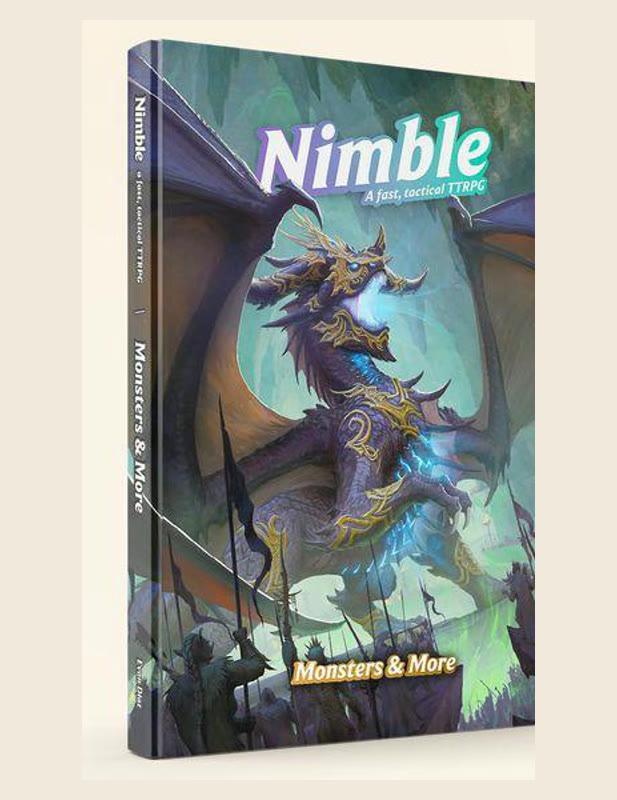
32:45Evan: I've got some other projects, some I can't talk about. I would love to do a full-length campaign adventure. I think that would be a lot of fun. And I have a project tentatively called Kid Nimble: a version for kids that's a lot more tactile and easier to pick up and play, for eight to ten year olds, elementary school age. I've been working on that, and lots of other things. But right now, everything is focused on fulfilling the current Kickstarter.
33:22Blaine: Awesome. Do you know roughly when that's going to go out?
33:27Evan: I'm hoping that by the end of the year, all the digital stuff will be done and sent, and everything will be at the printers. Once the files are at the printers, it's not up to me anymore. However long they take to manufacture and ship it is out of my hands. I need them to hurry up.
33:46Blaine: Yeah, me too. Another thing I noticed is that you handled the art direction in your book. How was that? Because the art is gorgeous. One of the things I look for in an RPG book is a cohesive art style throughout. You can't have one page looking wildly different from the rest. Did you have a lot of say in that?
34:15Evan: Yeah. With the success of the most recent project, I was able to have a lot more control over it. With the earlier projects, I didn't have much budget to work with. The biggest problem is telling artists, "No, I don't like this, let's start over," because I'm an artist too. I hate doing that, but you've got to sometimes. If I can provide a clear brief, and they're artists I know and trust, everything generally goes pretty smoothly.
34:45Evan: And I like to be surprised by what they come up with. That's one of the coolest things. A lot of times I'll have an idea in my head, and the artist gives me something else, and I say, well, that's way cooler than what I thought. And I'll design things around the cool art they made. I really like that.
35:07Blaine: That's awesome. Well, we're going to wrap up here. Is there anything you want to say before we go?
35:15Evan: No, no, that's it. I really appreciate you guys reaching out and chatting with me.
35:19Blaine: Awesome. I really appreciate it. It was a lot of fun. Maybe we can do this again when Monsters & More comes out.
35:26Evan: Yeah, definitely.