Stop Describing Rooms
What your read-aloud should tell players instead
By Blaine · · 6 min read
Greetings all,
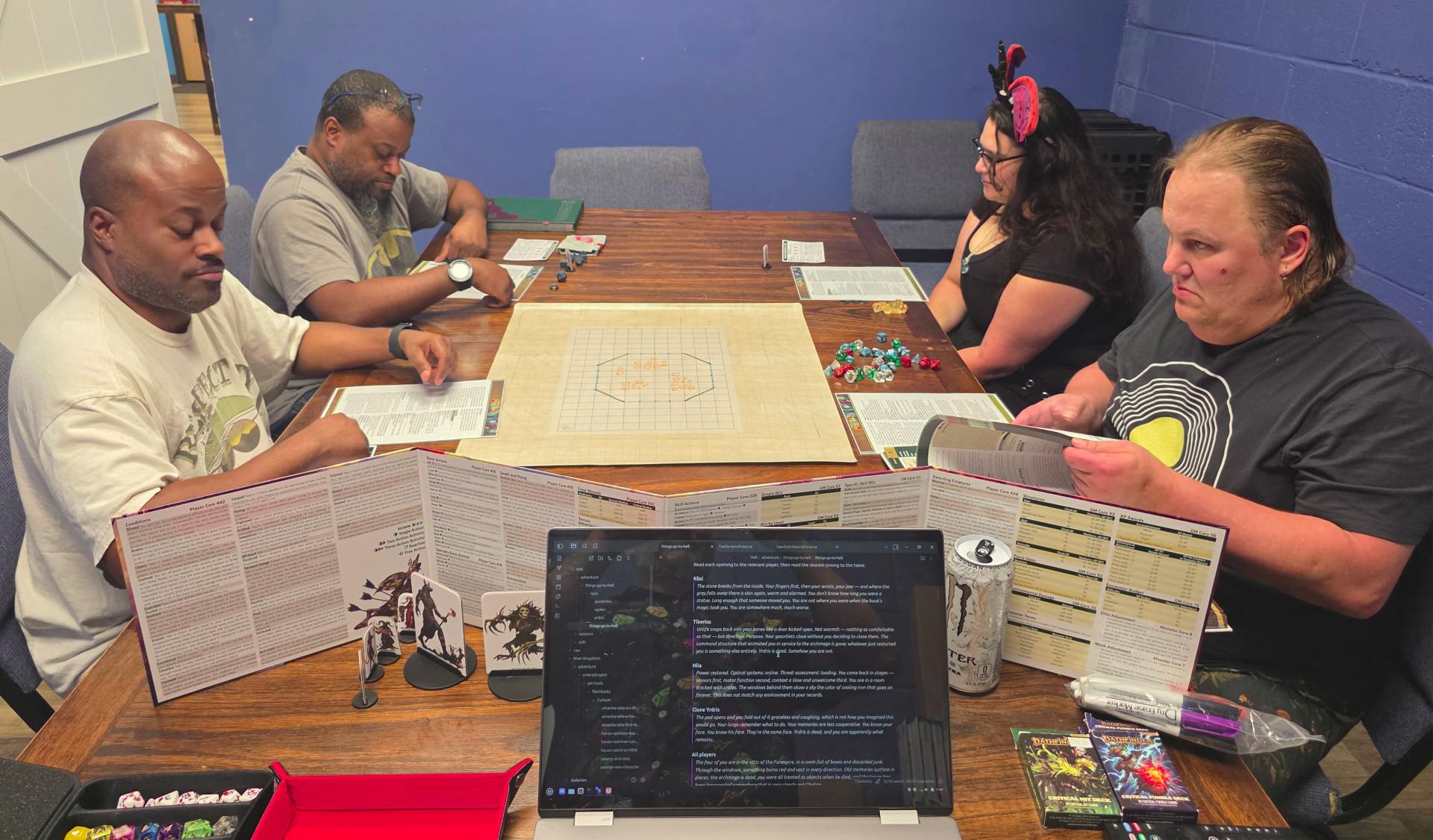
Back to Free RPG Day one more time. Same Free RPG Day table as The Three Asks, different lesson. I ran Paizo’s Things Go to Hell: a level-seven one-shot, set in Hell, pregens included. Good bones for a con table: fast setup, clear structure, stakes that escalate cleanly. Before I sat down to run it, I rewrote every read-aloud in the adventure.
Not to fix bad writing. The original text does its job. But “doing its job” for published adventures usually means one thing: establishing geography. What’s in the room. What color it is. Roughly how big.
What it never does is tell players what kind of situation they’re in.
I’ll come back to what happened when one of the PCs walked into a room and saw four statues of themselves.

The PCs wake up in the attic. The original read-aloud describes an octagonal chamber with stacked boxes and windows overlooking a cityscape. Players know where they are. They don’t know what it feels like to be there.
Here’s part of the version I ran:
Four vast panes face the cardinal directions, each one floor-to-ceiling, each one showing the same thing: a city without end. Iron towers crowd the horizon in every direction, black against a starless sky stained red from below. There is no sun. There is no moon. The air on your side of the glass is stale and closed; whatever is on the other side does not get in.
This is not Cheliax. This is not anywhere you have been.
The full read-aloud has one more line worth pulling out: “the ceiling seems to reflect a night sky, though the stars don’t match anything you’ve seen before.” Not as decoration. That line does a specific job: it tells players the wrongness of this place is baked into the physics, not just the scenery. Two more details from the same rewrite. The walls: cold and smooth. Not stone. Congealed shadow. The smell: sulfur seeping through the floorboards.
None of those details are in the original. And none of them just add texture. Each one carries a signal.
That’s what a tonal cue is. A detail that tells players something beyond its literal content: about threat level, about register, about what kind of story they’re standing in. Not what’s in the room. What the room means.
Published adventures almost never do this, and it’s not a criticism of the writers. Read-alouds have a real constraint: they’re written for a generic table, with generic PCs, in a system where any GM might be running them. The safe move is geography. Describe the room accurately, let the GM do the rest.
The problem is that most GMs don’t do the rest. They read it as written, move on. And then wonder why the dungeon crawl felt a little flat, why players were waiting to be told what to think rather than reading the room themselves.
Players are sitting at a table. They can’t feel the cold stone or smell the dungeon air. They can’t hear what’s on the other side of the door. All they have is what we give them. Tonal cues are how we close that gap.
If you’ve been adding sensory layers to your read-alouds, good. First move done. This is the next one. Because “the air smells of dust and old stone” is still just more information, and information alone doesn’t make players feel anything. A detail with a signal inside it does.
For the library scene in Hell, I knew one thing before I wrote the description: players should feel outmatched before they ever try anything. Not told they’re outmatched. Feel it.
The solution wasn’t to write “this creature is very powerful.” It was Gosterion moving through the library with “the absolute ease of something that has never, in its long existence, been in a situation it did not control.” His rolled contracts hanging from his horns like a grotesque filing cabinet. The way he cuts his sentence short when he sees the PCs, not alarmed, just recalibrating.
None of that tells you his stat block. It tells you something more useful at the table: don’t fight this one. Players caught it without a single Recall Knowledge roll.
For each detail I write, I ask the same question: what does this tell the player beyond its literal content? A large plush chair by a window does nothing. A plush chair arranged so its occupant can gaze out while thinking tells you this creature is patient, deliberate, at home here. It earns its place in the description because it works.
Before writing any major scene, ask yourself one question: what should this room make players feel?
Not what should they know. What should they feel.
Disorientation. Dread. The sick certainty of being outmatched. The warmth of a room that won’t hurt you. Then find the one detail that delivers that feeling without naming it.
The foyer of the Fanespire. My prep note to myself, before I wrote the read-aloud: the certainty that this room was staged, that you walked into something prepared. That note told me what I was selecting details toward. Players never heard it. They heard the silence that shouldn’t be there. The skeleton posed like a trophy on display. They wanted to look before they moved. Nobody told them to.
That’s the difference between a tonal cue and a mechanical prompt. A mechanical prompt tells players where to look. A tonal cue makes them want to look, because the room already feels like something is looking back.
Horror makes this obvious. A horror adventure doesn’t work if you just describe what’s there. The cold chill when a door swings open on a child’s playroom in a house where no child has lived for years. The faint sound of laughter somewhere down the hall, there for a moment and then gone. You don’t know if you heard it or imagined it. That uncertainty is the tonal cue. You didn’t describe a monster. You described not being sure. Neither of those is a description of an object. They’re descriptions of what it’s like to be a person standing in that space.
But it’s not just horror. A tavern where the fire hasn’t quite caught, where the barkeep refills drinks without being asked. Safe haven. Players feel it. They relax. They make different decisions than they’d make in a room that feels wrong. They don’t need to be told which one they’re in. The description tells them.
Back to the statues.
One of the pregens in Things Go to Hell is a clone of the wizard, grown as a backup body, discarded when the original decided it was half-baked, probably not useful. Same face. Same hands. Same contemptuous half-smile.
The foyer of the Fanespire has four enormous statues of Yrdris, each one staged in his own entrance hall to inspire awe or fear. When I wrote the Clone Yrdris memory fragment for this scene, I had one target: the player should feel the specific anger of someone who was made to be used.
Four statues. Your face. Your hands. Your contemptuous half-smile, rendered in permanent stone and displayed in his own entrance hall. You remember the sculptor, dimly. The original held very still for three days and called it the most productive work he’d done all year. He never once looked at you during the sittings. You stood in the corner and watched him be immortalized and thought: I have his face. I have nothing else.
I didn’t write “Clone Yrdris feels anger.” I wrote the detail that contained the anger. He never once looked at you during the sittings. The player found it themselves. Went quiet. The kind of quiet that happens at a table when something actually lands.
That’s the technique proving itself. Not atmosphere for its own sake. Not five senses checked off a list. A detail that carries exactly the feeling the scene needs. No announcement. Just trusted to do its work.
The work happens in prep. Ask what the room should make players feel, then find the detail that delivers it. Load those signals into the text. By the time you sit down to run it, the room is ready.
At my Free RPG Day table this year, a player ran out of words in front of a stone face that looked just like theirs. The description did that.
Not me.
See you at the table.
If this landed, subscribe — new posts every week. And if you’ve got a table story that fits, drop it in the comments. I read every one.