The Three Asks
The questions that make your world theirs
By Blaine · · 6 min read
Greetings all,
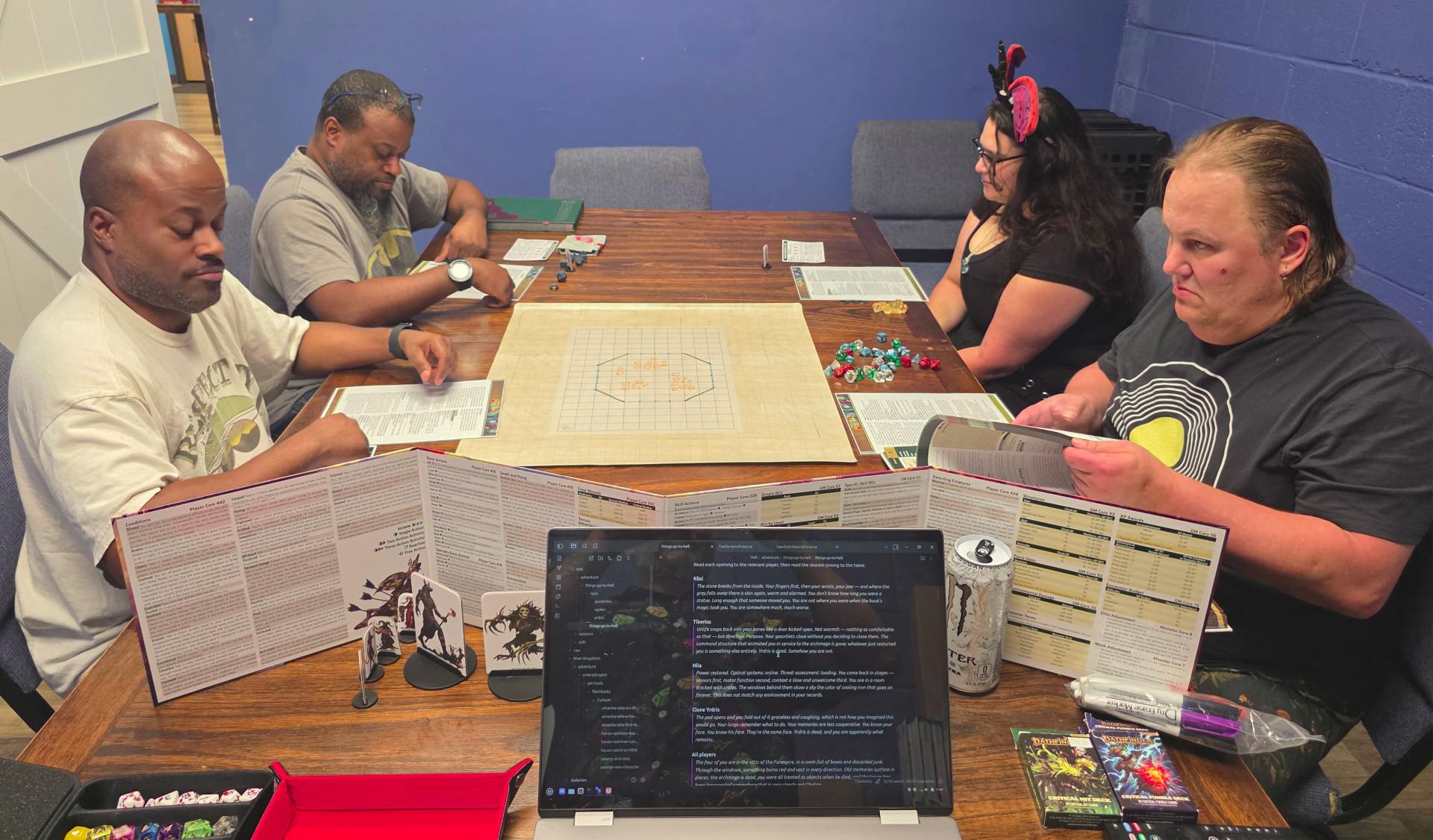
The wizard cast Telekinetic Projectile. I asked: “What do you throw at the devil? What in these crates and boxes catches your eye?”
She looked at me like I’d asked the wrong person. We were running Paizo’s Things Go to Hell at Free RPG Day: a 7th level Pathfinder 2e module, four strangers at my table. I rattled off a few ideas to get her going. She asked if there was anything silver in the room. Sure, I said. She asked about a small silver statue.
I said yes.
She hurled it at the devil.
I already knew the devil was vulnerable to silver. So when I described the impact, I described the statuette leaving a burn mark in the shape of it, seared into the devil’s skin. The table went quiet. Then someone said “oh, that’s cool.”
I didn’t plan that. She built it.
Most GMs don’t ask
That moment happened because I asked. Most GMs don’t.
The default is to describe everything yourself. You’re the narrator. They’re characters inside your narration. That works. But it keeps the world yours. Players live in it without belonging to it.
I didn’t always ask either. I picked it up. The thing that sharpened it was running Daggerheart at Phoenix Fan Fusion, GM’ing for Darrington Press through Nexus Entertainment, my first time with the system. I noticed something in how their adventures are written. They callout specific moments where you should ask the players a question and weave the answer into the scene. I’ve read a lot of modules: Pathfinder, D&D, and plenty of others. I’ve never seen that in any of them. It’s just not how those adventures are written.
Seeing it as a deliberate technique made me realize I was already doing a version of it: asking players to describe their spells, their finishing moves. Not something I did early in my career. Something I picked up. But I was doing it without fully understanding why, and only in combat. It made me think: where else could I be asking?
Players aren’t used to it. At Free RPG Day the wizard wasn’t sure if she was allowed to answer. Two of the four were twins who’d been gaming together for years. They hesitated just the same. Most games don’t open that door. Players learn to wait.
But she answered. And her answer was better than anything I’d planned for the room.
The Three Asks
I started pushing those questions further. Bigger ones. Questions about characters, about the world. After enough sessions, I noticed they fall into three types that each work differently. I haven’t seen this named anywhere, so I’m naming it. I call them the Three Asks: the Moment Ask, the Scene Ask, and the World Ask.
The Moment Ask
Most GMs already do some version of this. “What does your spell look like?” “How do you want to do this?” That last one Matt Mercer made famous on Critical Role, and for good reason. It hands the player the finishing blow. They describe it. They own it.
If you’re not doing this, start today. It costs you nothing and it makes every player feel like they’re in the world, not just watching you describe it.
But the Moment Ask doesn’t have to be about combat. It doesn’t even have to matter to the scene.
“As you slow your horse down the dusty road, what in the treeline catches your eye?”
“You’re walking the streets of Night City. What’s down the alley you just passed?”
Those questions don’t change anything. Nobody rolls dice. The plot doesn’t move. But your player just saw something. They put themselves in that world for a second. And that second is what they remember.
The Scene Ask
This one goes deeper.
The Scene Ask is about emotion, character, and relationship. You’re not asking what’s in the room. You’re asking how your player’s character feels about what just happened.
Your party just survived a brutal fight. One PC threw themselves in front of an explosion to save another. The smoke clears. Everyone’s alive. Most GMs move on. Next room, roll initiative. But you could stop and ask: “How does your character feel toward X right now? They just put themselves in harm’s way for you.”
That question does something. It makes the player think about their character as a person, not a stat block. Most players don’t do that naturally. We’ve grown up on video games. You don’t sit there thinking about how your character feels after a cutscene. You hit the next prompt. TTRPGs are different. That’s the whole point. But it’s a learned skill, and a lot of players haven’t learned it yet. Asking teaches it.
It works in quiet moments too. In a recent campaign, a player’s character had lost his children to undeath. When he found them again, I stopped. I asked what his character felt, seeing them like that. Players who’ve never been invited to go there will surprise you when you finally ask.
Or after a gig that should have killed half the crew, sitting in the neon glow of a bar: “Does anyone give a toast? What do you say?”
Night City is dangerous. The dungeon is dangerous. Your players know that mechanically. The Scene Ask helps them feel it. That’s what separates a TTRPG from loading up a video game.
The World Ask
This is the one that persists.
Most GMs have at least one book that gives them a city: locations, shops, named NPCs they can visit. That’s a drop in the bucket of what’s actually in a living city. Unless you’re running a ten-building hamlet, there’s a whole world those books don’t cover.
I see myself as a visitor to this world. I built it, but I don’t live in it. The characters do. They grew up here. They have a favorite bar, a merchant they trust, a street they avoid at night. I don’t know any of that. So I ask.
“What’s your favorite shop in this district? Why?”
A player might struggle with a name. That’s fine. “A bakery run by a little old gnome woman” is enough. You name her. You describe the smell when they push the door open next session. Now that shop is theirs.
When that bakery shows up in session six, the player who named it notices. When it burns down, they care. When the gnome baker gets kidnapped, it’s personal. That didn’t happen because you put it in the world. It happened because they did.
Compare that to a location you hand them. You describe the famous tavern from the guidebook. They walk in. It’s fine. It means nothing. They didn’t build it. It’s yours, not theirs.
One thing worth addressing
Justin Alexander over at The Alexandrian makes the argument that asking players to create content can undermine discovery. If a player was hoping to find out what’s in the treasure vault, asking them to tell you hands them the answer to the mystery they were trying to solve.
He’s right. But that’s not what the Three Asks are.
None of this is about plot. It’s about flavor, emotion, and personal detail. None of it has a right answer you’re sitting on. What does your spell look like? How does your character feel right now? What’s your favorite bakery? Those aren’t discoveries. They’re expressions.
The rule: never ask a question you already know the answer to. The silver statue was mine to give or take. What I asked was what she wanted to use. There was no wrong answer. That’s what makes it a question worth asking.
Use it
Ask everyone. Not just the player who takes the flashy action. The quiet one at the end of the table has something to build too.
Since I started using the Three Asks consistently, my players have become better roleplayers. They’re more engaged. They add to the world instead of waiting for me to describe it. Every player who gets asked has something in the world that’s theirs. The world stops being mine and starts being ours.
The burn mark in the shape of the statuette is in the fiction now, because a player put it there. Your table has details like that waiting. You just have to ask.
See you at the table.
If this landed, subscribe — new posts every week. And if you’ve got a table story that fits, drop it in the comments. I read every one.
More GM tips
- Stop Describing Rooms
GM Tip
Stop Describing Rooms
What your read-aloud should tell players instead
July 7, 2026 · 6 min read
GM Tip
Session Zero Ends Before the Tavern
The session where nobody meets anybody
June 18, 2026 · 7 min read
GM Tip
Plan a Villain, Not a Campaign
Session prep for homebrew campaigns
June 15, 2026 · 7 min read