Session Zero Ends Before the Tavern
The session where nobody meets anybody
By Blaine · · 7 min read
Greetings all,
We’ve been working through prep: published adventures first, then building your own. This week finishes the series: session zero, where you find out what you’ll actually be prepping for. (Players, your version of this article comes later in the series. Meanwhile, this one tells you what your GM is up to.)
Four strangers met in a tavern.
I know. Stay with me.
Halfway through our campaign’s first session, we played a flashback: the goblin’s escape from the Spire, three weeks before the campaign begins. His character had been drinking at that tavern ever since, barely sleeping, never saying why. The other players ran the monsters chasing him out, and every hit they landed made his escape harder. They landed plenty. He failed every challenge, and his character still carries the three scars to prove it.
Then his player told us about the ones who didn’t come out at all. The two smallest were his children. The woman who fell in the clearing behind him was his wife.
Nobody at the table moved. The other players had just been the monsters.
That moment is the best thing that’s happened at my table this year, and it grew straight out of the most boring session I ran this year: session zero, two weeks earlier. Nobody met anybody. Nobody rolled initiative. We talked about calendars, cancellations, house rules, and character sheets, and then we went home.
The tavern wouldn’t have worked without it. I’ll show you why.
The Checklist Isn’t Wrong. It’s Aimed Wrong.
You can find the standard session zero checklist anywhere now; the 2024 Dungeon Master’s Guide even ships with one. Tone, expectations, what kind of game everyone wants. Fine. Cover it. It takes twenty minutes.
But the checklists treat session zero as a vibes meeting, and the thing that actually kills campaigns gets one bullet near the bottom. I said it last week: campaigns don’t die in a blaze of glory. They die to schedules. Session zero is the only moment you’ll ever have everyone’s full attention on that problem, before anyone has a character to hide behind.
Spend it there.
Lock the Calendar First
Pick the day. Pick the cadence. Say the quiet parts out loud: what time we actually start, what time we actually end, whose house, who brings what.
Then agree to the rule that matters more than the schedule: when life changes, we change the schedule on purpose. Out loud, together.
My table meets every other week. We started weekly, and when I joined a second game as a player, we renegotiated instead of letting it slip. Biweekly keeps it from being too much for anyone. The difference between a schedule that changed and a schedule that slipped is the difference between a campaign and a memory.
Decide Now What Happens When Someone Cancels
Someone will cancel. If you haven’t decided what happens, every cancellation becomes a group text negotiation, and that way lies the slow death.
I run a table of four, so one empty chair is a quarter of the party. Here’s my ladder:
Missing one player? We still play, but the main story pauses. Instead, I run a flashback: a scene from before the campaign where the three present characters were together. A job that went sideways. The night they ended up owing someone money.
The flashback doesn’t fit? Then I build one around characters I make: a scene from the region’s past, tied to a backstory or leading up to the events the campaign sits on. The players run those characters for a night.
Two players? Still a flashback. One? We cancel, guilt-free, because we agreed on the line in advance.
One rule inside those flashbacks: loot is consumables and coin only. Never permanent items. A potion that comes home is a small bonus for showing up; nobody audits where a potion has been. A magic sword has to explain where it’s been every session since.
The absent player misses nothing on the main road. The people who showed up still get to play. And every flashback makes the world deeper, because the past gets table time the present never has room for.
Hand Out the House Rules. On Paper.
Confession: I talked through my house rules at session zero. Hero point changes, secret death saves, all of it. I never handed out the document. Months later I still haven’t, and every time a house rule surprises someone mid-session, that’s my fault, not theirs.
Don’t be me. Bring one page. Update it when rulings happen, because they will. A house rule that lives in your head is a surprise. A house rule on paper is a rule.
Character Creation Is a Harvest
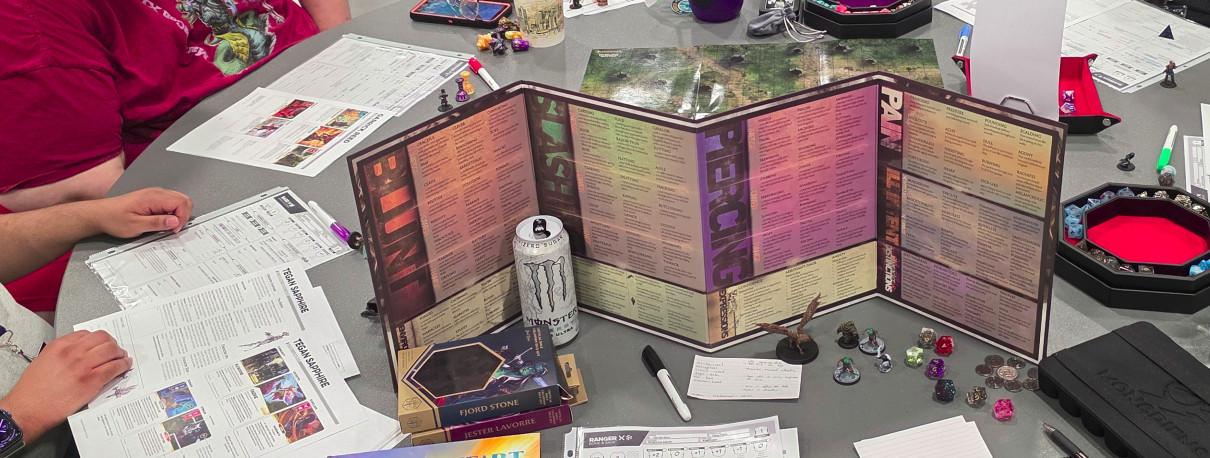
Make the characters together, at the table. Not because the checklists say so, but because of what it produces for you.
Watch what happens between the players. At our session zero, my wife Monica and our friend Heather linked their characters on their own, unprompted. One connection, out of four players. That isn’t failure. That’s a start, and it’s one more connection than solo character creation has ever produced.
These days I set a floor: every character leaves session zero connected to at least one other character. Overlap is fine. Nobody starts alone. Daggerheart bakes this into character creation with connection questions, and the move ports to any system: go around the table, each player picks one other character, and the pair answers how they know each other. When I ran Daggerheart for another table, everyone picked one connection and the party arrived pre-welded. No tavern small talk required. No time for questions? Do the blunt version from my other campaigns: you’re all friends, or you all live and work in the castle, and you’re the ones they sent with Marlowe. A thin connection beats a blank one.
The rest came home with me as raw material: four classes, four backgrounds, the first knives. I built the missing connections in the two weeks after, out of the backgrounds they’d picked. The barbarian had crossed paths with the goblin’s tribe before. The wizard’s master had a reason to send him to town. None of that existed at session zero. All of it was implied by what session zero handed me.
That’s the reframe: session zero isn’t a meeting you run for the players. It’s a harvest you run for yourself. Classes, backgrounds, connections, who sits forward when which idea comes up. You’re not setting expectations. You’re collecting the material your next two weeks of prep need.
Skip it and there’s no harvest: every personal stake in the campaign gets invented from nothing, forever. No connections means you need a reason these people keep risking their lives together, and “you met in a tavern” can’t carry that weight. When was the last time you risked your life alongside a stranger you met at the game store? When did you last sleep in the wilds beside someone you met that morning? The blunt version keeps a one-shot moving. A campaign stands on the party itself, and the party doesn’t exist yet.
Nobody Meets in a Tavern (Yet)
Here’s where I break with every checklist: session zero ends before the party meets.
There’s always pressure at the end of session zero to “just play a little.” Resist it. I can’t plan a good group meeting until I know who’s coming: the classes and backgrounds, and which connections are worth engineering. The meeting isn’t a formality to burn off in leftover minutes. It’s the campaign’s first scene, and it deserves the full prep treatment.
Back to that tavern. Everything that landed in our first session was built in the two weeks after session zero, from the harvest. The wizard hit the tavern first because his background handed him a bounty, and found the goblin there; the barbarian’s flicker of recognition (”wait... I know you”) existed because I’d tied her past to his tribe. And the flashback we played existed because the background he picked at session zero made him a survivor of the Spire. His sheet said nothing else. The three companions, the weeks of drinking at the tavern, the chase to the treeline: none of that existed yet. I built it in those same two weeks, out of his one choice.
I built that stage. Then his player walked onto it and brought the knife. His wife. His two children. Not pre-planned, not mine: his choice, made in a scene that only existed because session zero told me what to build.
Run the meeting at session zero instead, and none of that scaffolding exists. Four strangers in a tavern, making small talk, with nothing underneath.
Session zero should end with finished character sheets, a calendar everyone swore at, a missing-player plan nobody hopes to use, and a one-page handout of house rules. No dice. No tavern.
The tavern is coming. And when your players finally walk into it, you’ll know exactly who just walked in. One of them is going to bring a knife you didn’t put there. Your job was the stage.
See you at the table.
If this landed, subscribe. New posts every week. And if you’ve got a table story that fits, drop it in the comments. I read every one.
More GM tips
- Stop Describing Rooms
GM Tip
Stop Describing Rooms
What your read-aloud should tell players instead
July 7, 2026 · 6 min read
GM Tip
The Three Asks
The questions that make your world theirs
June 29, 2026 · 6 min read
GM Tip
Plan a Villain, Not a Campaign
Session prep for homebrew campaigns
June 15, 2026 · 7 min read