Every Room Has Neighbors
The question a full GM brain forgets to ask
By Blaine · · 6 min read
Greetings all,
Back in Prepping a Published Adventure, I told you to stick a Post-it on the map so the monsters in area 4 come running when they hear a fight in area 2. In Stop Describing Rooms, we worked on how a room feels. This one’s about what happens around the room once the fighting starts.
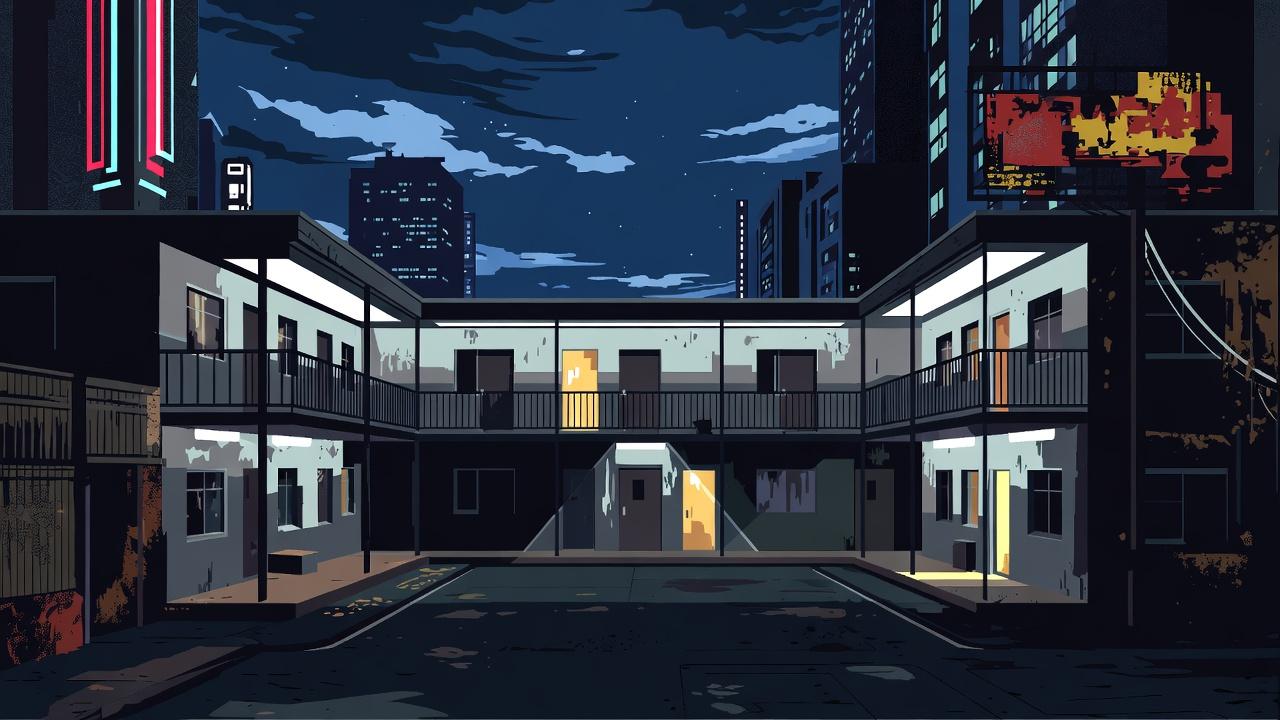
It was supposed to be a pickup. A package, a target, a cheap hotel in Watson. The kind of place that’s really a motel: two stories wrapped around a courtyard in a U, every door opening straight onto the walkway. My players were a Solo, a medic, and a fixer, and they came in mouthing off.
Then they threatened him.
Then the guns came out.
In most games, that’s the whole scene. One room, one stat block. Roll initiative.
It wasn’t the whole scene. I’ll tell you how it ended, and what it cost them later, at the end of this post.
The fight eats your whole brain
Here’s what’s in a GM’s head the second initiative starts. Whose turn it is. How much damage the target has taken. What he does on his turn, and whether he’s smart enough to take cover. What the Solo just rolled, and whether that’s a hit. The rule you half remember and don’t want to stop and look up.
That’s a full head. Nobody’s bad at this. It’s just more than one brain holds comfortably, so something falls out.
What falls out is everything outside the fight.
The fight becomes the whole world, and the hotel around it goes quiet. It wouldn’t be quiet. You’ve just got no room left to think about it. Your players shoot their way through a building and nobody in the building notices. The world holds still and waits for them to finish.
Published adventures don’t help. They describe the room. The generous ones add a line: if combat breaks out, the guards in area 4 investigate.
And players learn from that silence. Every fight that costs nothing outside the fight teaches them the violent answer is free.
Look up
The fix is small. When the first shot goes off, stop for a few seconds and look up from the fight. Ask:
Who’s around? Enemies, sure. But also neighbors, staff, anyone passing through, anyone who just happens to be standing there.
What can they see, and what can they hear? This is the part people skip. A gunshot carries. A whispered threat doesn’t. Some people will know exactly what’s happening. Some won’t hear a thing, and that matters too.
And what would they actually do about it? Run. Call someone. Stay behind a locked door. Or come out with a gun, because the person getting shot at is their friend.
That’s it. A few seconds. The hard part is remembering to do it at all, and I’ll get to that.
In Watson, the neighbors heard
A motel like that has no inside. Every door opens onto the same walkway, and every walkway looks across the same courtyard. When the guns came out, the people around that courtyard heard.
And the people who heard it knew the target.
The neighbor across the courtyard came out first, to help him. Then the neighbor next door. Then a guy who’d been standing in the courtyard when it started, and picked a side.
None of them needed stats I’d written ahead of time. A mook stat block covers a neighbor with a pistol. What they needed was a reason to open the door, and people who live that close together know each other. Somebody’s shooting at your friend, you come out.
Same goes for a dungeon
The Post-it from Prepping a Published Adventure made the dungeon answer a fight. Here’s what it skipped: a lot of dungeon noise happens before anybody rolls initiative, and not every noise gets the same answer.
Did the group pry open a chest? Kick down a door? Cast a lightning bolt down a hall?
Each one is a moment to look up. Ask the same question you’d ask in Watson: is this enough that whoever lives here would come defend their home? And if it is, what does that look like?
A door breaking gets attention, not an army. Maybe one or two come to see what that sound was.
A lightning bolt down a hall is different. That’s a thunderclap in a stone corridor. Everyone’s coming.
Match the answer to the noise. Too little and the dungeon feels dead. Too much and every door turns into a fight, and your players stop opening doors.
Do the thinking before the fight
Here’s the catch: the whole problem is that your head is full mid-fight. So don’t do all the thinking there.
Do it during prep, when your head is empty. That’s what the Post-it is for:
Hotel, Watson. Across the courtyard and next door: the target’s friends. They’ll hear it. They come out on the first shot. Whoever’s in the courtyard picks a side.
Now when the shooting starts, you’re not inventing a neighborhood from scratch. You’re reading a note. Looking up takes one second instead of ten.
Same move underground:
Area 2, guardroom. A door breaks: two of them come to look. Anything louder: the whole warren comes.
Give the world a turn
Here’s my confession. I know the dungeon turn. Justin Alexander lays out the whole procedure in So You Want to Be a Game Master, patrol routes and all, and it’s excellent.
I still forget it.
It’s one more piece of paper. One more thing to reference while I’m already tracking whose turn it is and how much damage the target has taken. The procedure was never my problem. The habit was. And a habit needs something to trigger it.
So I went looking, and while I was brainstorming I landed on D&D’s lair actions. The lair gets its own turn. On initiative count 20, the dungeon itself acts.
I’m stealing that, with one change. Here’s what I’m trying: add the world to your initiative order. Call it World. It always goes last.
Last matters. The lair acts to set the stage. The world goes after everyone else, so it answers them. When World comes up, stop and ask: what’s the world’s reaction to what the players just did? Who heard it, and what are they going to do about it?
If you like something you can see, put an extra mini on the table. An invisible one, standing in for the world. It sits there all fight, reminding you to take that moment after the players have gone.
Outside combat there’s no initiative to hang it on. So put a note on your screen: Who heard that? Every time something loud happens, your eyes land on it.
Out the back window
Back to Watson.
Cyberpunk is deadly. I love that about it. A couple of bad rolls and your Solo is bleeding out on a walkway.
My players didn’t win that fight. They survived it. With the target’s friends coming out of their rooms, the party ended up pushing into the target’s own apartment and going out the back window. All three of them were pretty messed up by the time they cleared it.
Most players don’t come in expecting that. They come in on hero fantasies, where a strong enough party can shoot its way through almost anything. A world that doesn’t react protects that fantasy. A world that does react breaks it, and fast.
After that night, they kept their attitude on a shorter leash. Not all the way. Enough. They’d learned combat wasn’t always the best tool they had.
Fights still happen. They just have neighbors now. Once your players believe the building is listening, talking starts to look like a real option. So does leaving.
And the target? He had ties to 6th Street.
That fight didn’t end at the back window. It led to a later run-in with 6th Street. The target had friends outside that hotel too.
So next time the dice start flying and your whole brain narrows down to the initiative order, look up. Look at the doors next to the fight. Somebody lives there. And they heard everything.
See you at the table.
If this landed, subscribe — new posts every week. And if you’ve got a table story that fits, drop it in the comments. I read every one.
More GM tips
- Stop Describing Rooms
GM Tip
Stop Describing Rooms
What your read-aloud should tell players instead
July 7, 2026 · 6 min read
GM Tip
The Three Asks
The questions that make your world theirs
June 29, 2026 · 6 min read
GM Tip
Session Zero Ends Before the Tavern
The session where nobody meets anybody
June 18, 2026 · 7 min read