The Beginning
A 30-year journey from Rifts to Daggerheart, and an invitation
By Blaine · · 4 min read
Greetings all,
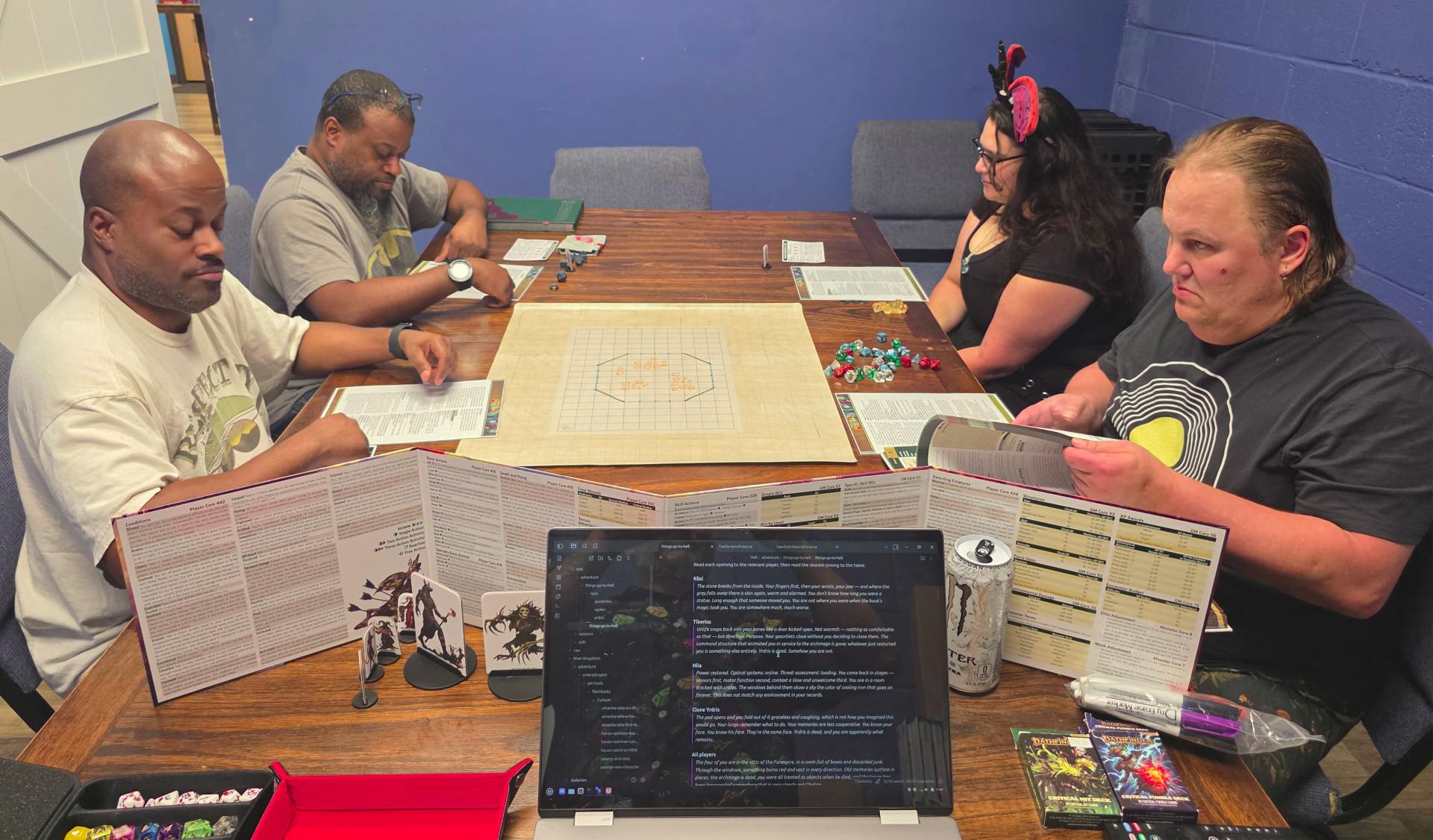
This little corner of the internet isn’t just a blog. It’s a campfire. A place to gather, swap stories, and remind ourselves why tabletop roleplaying games matter. At their core, TTRPGs aren’t about stats or “winning.” They’re about friends crowded around a kitchen table, laughing as a rogue accidentally sets a tavern on fire. They’re about siblings teaming up to fight dragons, or coworkers unwinding after a long week by escaping to a spaceship. They’re about building memories that feel more real than the ones we live.
I’ve been chasing that feeling for over 30 years now.
Let me tell you about the game that hooked me forever.
I was 13, an early alt kid, when a new kid named Frank transferred to my school. We bonded over music and movies, but everything changed the day he pulled out a dog-eared Rifts rulebook by Palladium Books. The art alone blew my mind: cyborgs and dragons and laser cannons colliding in a kaleidoscope of chaos. Frank handed me a character sheet and said, “You’re piloting a Glitter Boy. Don’t blow up the orchard.”
The orchard. I can still see it. Rows of apple trees stretching toward a horizon warped by dimensional rifts. My power armor’s jetpack roared as I soared over workers fleeing a skittering, chitinous thing that oozed acid. Panicking, I slammed my laser pylons into the earth to brace the recoil, then fired the Boom Gun. The blast atomized the monster… and half the orchard. Frank’s GM eyebrow arched. “The farmers say thanks. Also, you owe them 10,000 credits.”
To this day, I swear I can smell that moment: burnt ozone and apple pulp, the metallic tang of the Glitter Boy’s cockpit.
That’s the magic of TTRPGs. They make the impossible real. Not metaphorically real. Real real. Science is catching up to what storytellers have always known: consciousness shapes reality. When five people sit around a table and imagine the same world, feeling the same fear, the same triumph, the same grief, something happens that goes beyond memory. We’re not just playing pretend. We’re manifesting. Building something in the space between us that didn’t exist before we spoke it into being.
Your friends gasp when the dice betray them. Your dad still ribs you 20 years later about that time your paladin tried to baptize a goblin. Those moments aren’t just memories. They’re real experiences etched into real minds, shaping who we became. The orchard burned. The paladin believed. And somewhere, in some way we don’t fully understand yet, those realities exist because we created them together.
Since that first game, I’ve lived a hundred lives. I’ve been Leonardo from the TMNT, flipping over Foot Clan ninjas while arguing with Michelangelo about pizza toppings. I’ve bled out in a corporate arcology as a cyberpunk hacker, whispering “Delete my search history…” as my crew escaped. I’ve wept over fallen NPCs, thrown dice at scheming GMs, and stayed up until 3 AM debating whether a gelatinous cube counts as “vegan” (it does).
Thirty years. AD&D. Rifts. Shadowrun. TMNT. D&D 3rd, 3.5, 5e. Pathfinder. Cyberpunk. Shadowdark. Daggerheart. Robotech. Nightbane. Star Wars. Too many systems to count. Too many characters to remember. But I remember the moments. The triumphs. The disasters. The time my group fought for three hours to save an NPC who had no plot relevance, just because they loved him.
That’s why I’m here.
I want to build something. A community where GMs help GMs. Where the veteran who’s been running games since the 80s can share tricks with someone prepping their first session tonight. Where we talk about what actually works at the table. Not theory, not ivory tower advice, but the stuff that makes players lean in and say “holy shit.”
Whether you’re a first-time GM terrified of your upcoming Session 1, or a grizzled veteran looking for fresh techniques, pull up a chair. And if you’re a player thinking about stepping behind the screen for the first time? This is especially for you.
Here’s what nobody tells you: Every GM sucked at first. Every single one. That smooth-talking DM who runs flawless sessions? They fumbled rules, forgot NPC names, and killed the pacing of more scenes than they’ll ever admit. The difference between a bad GM and a good one isn’t talent. It’s reps. You run games. You screw up. You learn. You run more games. You get better.
It’s a skill, not a gift. And like any skill, practice beats theory every time.
I’ll share what I’ve learned: the wins, the failures, the house rules that saved campaigns, and the mistakes that killed them. No gatekeeping. No pretension. Just practical advice from someone who’s been rolling dice since before some of you were born.
Pull up a chair. Let’s roll some dice.
What do you want to see here? Session prep? Running combat? Handling problem players? Building worlds? Reply and tell me what you’re struggling with. I’ll write about it.
More GM tips
- Stop Describing Rooms
GM Tip
Stop Describing Rooms
What your read-aloud should tell players instead
July 7, 2026 · 6 min read
GM Tip
The Three Asks
The questions that make your world theirs
June 29, 2026 · 6 min read
GM Tip
Session Zero Ends Before the Tavern
The session where nobody meets anybody
June 18, 2026 · 7 min read