Pull the Thread
Start with the boss fight and work backwards.
By Blaine · · 5 min read
Greetings all,
Last week I told you that you don't have to write your first adventure. Grab a box, let someone else do the hard part, and learn the rules while you play. So you ran it. The party beat the boss, and your players are already asking when you're playing again.
Now what?
Now you write one. There are two ways in. You're either starting from scratch, or picking up where the last adventure left off. That last one might have been a starter box, another published adventure or something you wrote yourself. It doesn't matter. Either way, you end up in the same place: a boss fight.
Starting from scratch
I've pretty much always written my own adventures. Back when I started, there weren't starter boxes to lean on. My ideas come from everywhere. I flip through a monster manual (even one from another system), watch a movie, read a book or play a video game, and something sparks.
Sometimes it's a small spark, just the hint of an idea. Other times it's a big one, and I steal the whole thing. That's fine. We're running games for our friends. I've never heard a player complain that they're fighting the pale, one-armed orc from The Hobbit. We didn't complain as kids when we faced the Weasels from Who Framed Roger Rabbit in a TMNT game. Your players won't either.
What I'm really looking for is a cool boss fight. That's the foundation of my stories, and it decides the rest for me. This is my process, and it might not work for you, but I find the ending and work backwards. Once I have a villain, I either steal a motive from a movie or a game and build it out, or I already have a plan for the boss and for what pulls the players in.
Picking up where you left off
This one's even easier, because your next adventure is already hiding in the last one.
A lot of published adventures end with ideas for what comes next. Some go further. The Pathfinder Beginner Box has a whole second book of follow-up one-shots, Troubles in Grayce. When an adventure doesn't give you ideas, or you wrote it yourself, find the plot threads it left open and build off them.
So look at how the adventure ended, and pull on a thread.
Say the party recovered a merchant's stolen shipment from a band of goblins. Start asking questions:
- Were the goblins random? Or did someone hire them to steal it?
- Does the merchant need protection on the road from the small town to his bigger city? And when they get there, he tells all his friends about the heroes who saved his goods. Maybe one of them needs help too.
- Does the village throw a celebration for the heroes, right before more goblins attack? Or worse, the thing the goblins were working for.
Every one of those is an adventure, and you didn't have to invent a world to get it. The last adventure built the world. You just asked what happened next.
And now we find our next boss fight.
Find the motive
Either way, you've got a villain. Now figure out what they want. Everyone has a motive, even a villain who was hired by someone else. Whoever hired them has a motive of their own.
Those goblins aren't made up. They're from the one-shot I'm working on right now. Goblins waylay a merchant's cart and scurry off with some of the goods. The goblin clan leader's motive is to establish a new home. The goblins were sent out to expand into the area by the boss of their old home. They needed supplies, came across a well-used road, and hit the cart. What they didn't do was scout enough to know there's a village close by, and that the attack would draw attention.
That old boss is probably the next adventure, depending on which way the players want to go. They've been in talks with some other, more powerful force. Orcs, drow, something. I haven't decided yet, and that can change. This is where I leave the players items or bits of info they can decide to chase later, the way I talked about in Plan a Villain.
And just because the players go another way doesn't mean the villain stops. Say the merchant asks them to travel with him as protection, and they take the job. The other tribe's story still plays out without them. Maybe the old goblin boss sends someone to check on the new camp, and they find the goblins dead. So they come for the village and burn it down. If the heroes ever come back through, the world moved on without them. All of that comes from knowing the motive.
I haven't gotten too far into the motive, but there's enough. It helps me play the goblin boss, and it tells me what happened when the goblins moved in. I have my boss. I have my motive. And I have my problem for the players to solve.
Give them a problem
Now the players need a problem to solve. In my one-shot, the merchant rolls into the village disheveled and offers money to anyone who'll recover his stolen goods. But the village is small, and most of the people there aren't fighters or adventurers. That's the moment for the players to step up.
Most players will do it for the money alone. If I need more, I give someone a reason to need the coin, like a damaged roof they need supplies to fix.
If this is the start of a new story or campaign, I handle it at session zero. I make sure every player's background has a hook that drives them into the adventure. Curse of the Crimson Throne does this well: every character has a reason to hunt, or hate, Gaedren Lamm.
Keep it whole
Whichever way you start, the goal is the same as the box you just ran: a one-shot, or a few sessions, that tells a complete, really cool story. Along the way, the players face puzzles and challenges, and they feel something. At the end, they defeat the villain and get to feel like heroes. All of it fits inside one story arc.
Don't plan a campaign. I wrote a whole tip on that: plan a villain, not a campaign.
Your turn
That wraps up New GM November. You've run your first game, you've survived it, and now you're writing your own. Find a boss fight you'd love to run, or look at how your last adventure ended and find one thread worth pulling. New GM November has every tip from the month if you need a refresher.
For your next game, pull the thread.
See you at the table.
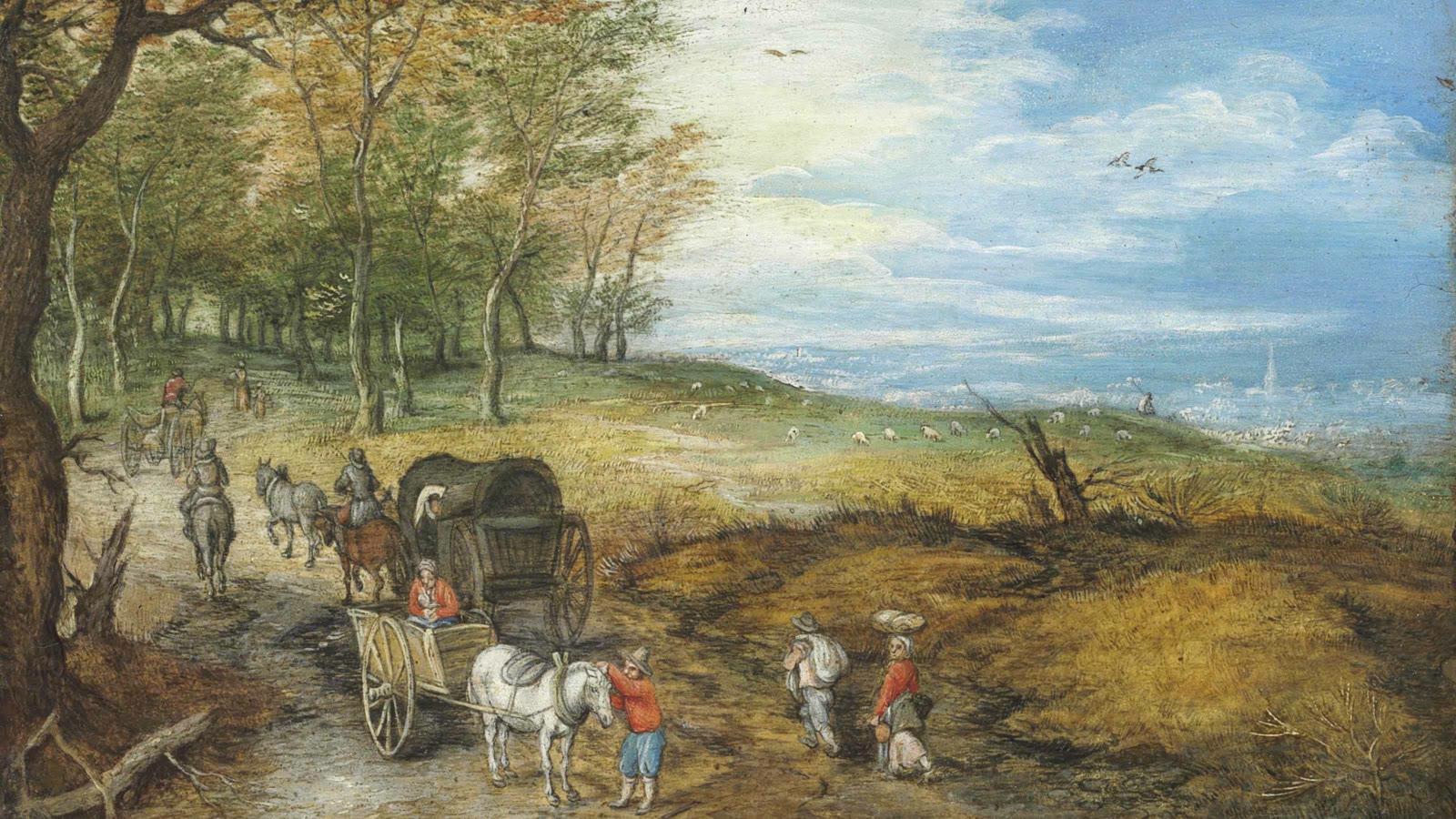
Header painting: Travelers with Carts and a Wagon on a Country Road, a City Beyond, by Jan Brueghel the Younger (public domain).